|
Evaluating Software Design Patterns — the "Gang of Four" patterns implemented in Java 6 |
||||||||
| PREV PACKAGE NEXT PACKAGE | FRAMES NO FRAMES | ||||||||
See:
Description
| Interface Summary | |
|---|---|
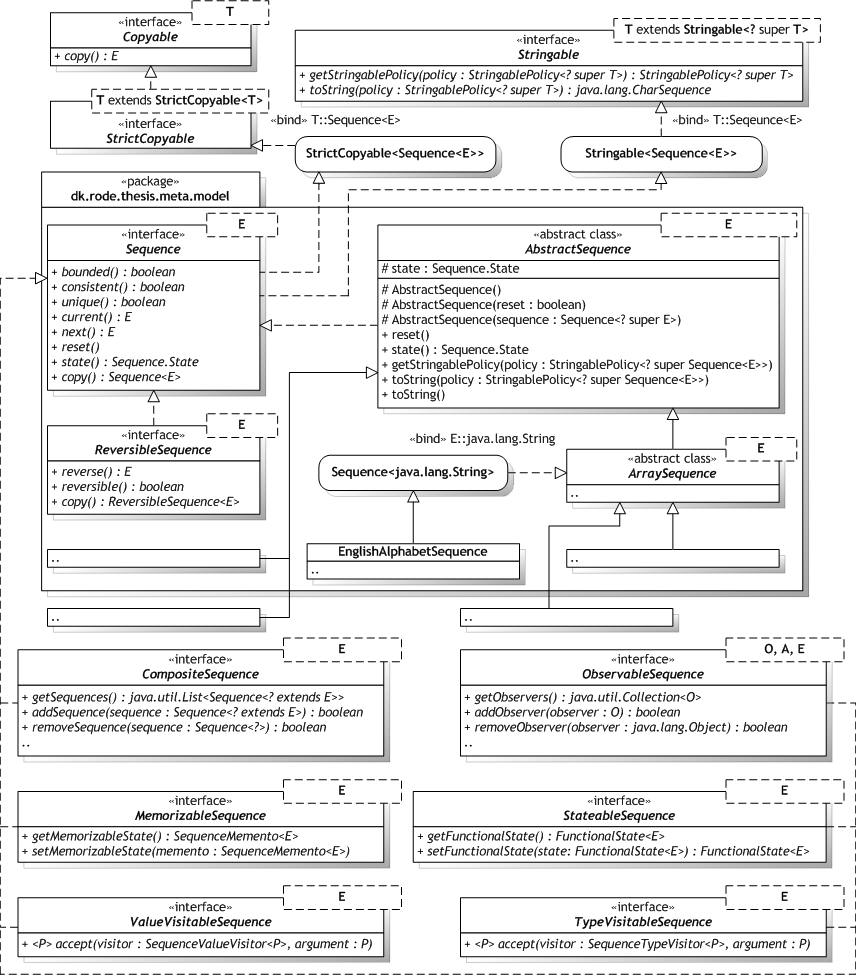
| ReversibleSequence<E> | A reversible sequence allows retrieval of previous
values if and only if such previous values are
ready for delivery, i.e. have
already been calculated. |
| Sequence<E> | Represents a sequence that will deliver the
next, or current,
value in the sequence on demand. |
| Class Summary | |
|---|---|
| AbstractSequence<E> | An abstract sequence implements the basic traits of
the Sequence interface. |
| ArraySequence<E> | A simple abstract array sequence to deliver all the entries in a given array, in order. |
| DigitSequence | A digit sequence contains the 10 digits in
the decimal system, in order from 0 to 9. |
| EnglishAlphabetSequence | An alphabet sequence for letters in the English alphabet:
a though z, lower-cased. |
| HexDigitSequence | A hex digit sequence contains the 16 digits in
the hexidecimal system, in order from 0 to A. |
| LongSequence | A long sequence represents an unbounded long value that
is increased with each call to LongSequence.next(). |
| PrimeSequence | A prime sequence returns with each call to PrimeSequence.next()
the next prime number in the sequence of prime numbers smaller
than maximum, where maximum is supplied at
construction time. |
| Enum Summary | |
|---|---|
| Sequence.State | The possible internal states a Sequence can have. |
Defines the common model objects used, primarily sequences and various general implementations used in the different evaluations.
|
Gunni Rode / rode.dk | ||||||||
| PREV PACKAGE NEXT PACKAGE | FRAMES NO FRAMES | ||||||||