|
Evaluating Software Design Patterns — the "Gang of Four" patterns implemented in Java 6 |
||||||||
| PREV PACKAGE NEXT PACKAGE | FRAMES NO FRAMES | ||||||||
See:
Description
| Interface Summary | |
|---|---|
| AdapterDelegate<S,T> | An adapter delegate determines how a value of
type S can be represented as type T. |
| Class Summary | |
|---|---|
| AdapterStrategy | Simple adapter strategies used in conjunction with
SequenceAdapter instances. |
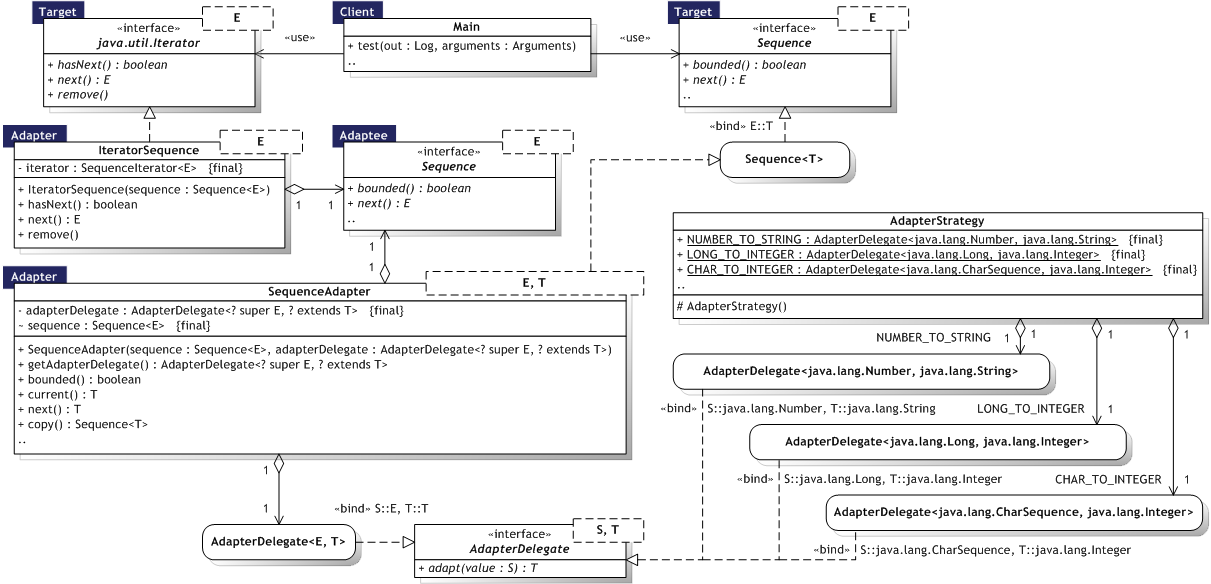
| IteratorSequence<E> | An object adapter that adapts a Sequence type
to conform to the Iterator type: when the iterator is
advanced, so is the sequence - hence the adaptation. |
| Main | Adapter tests. |
| SequenceAdapter<E,T> | The sequence adapter acts as a generic type adapter for
sequence parameterised types, i.e. from Sequence<E> to
Sequence<T>, by using an adapter delegate
to perform the representation shift. |
| Enum Summary | |
|---|---|
| AdaptedPolicy | Additional policies for formatting SequenceAdapter
objects into char sequences (not part of the core Adapter
implementation). |
Implementations and examples of the Adapter design pattern [Gamma95, p.139].
Intent:
Convert the interface of a class into another interface clients expect. Adapter lets classes work together that could not otherwise because of incompatible interfaces.
Sequence implementation,
for example HexDigitSequence.
The IteratorSequence and
SequenceAdapter classes
represent the Adapter participant.
An IteratorSequence has object scope. The Target
of an IteratorSequence is the java.util.Iterator class. An IteratorSequence thus allows
iteration over sequence values using standard Java iterators as oppose
to using the specific Sequence interface. The
IteratorSequence class does not implement the
Sequence interface.
A SequenceAdapter essentially has class scope, but is an
object adapter, and its Target participant is represented
by another Sequence declared with an incompatible type parameter.
It utilises AdapterDelegate instances to
perform the actual representation shift between types E and
T, for example from an Integer value to a String
representation of that value.
The Client participant is the test application, i.e. the
Main class.
Implementation notes:
The SequenceAdapter class is an object adapter in that
it forwards all sequence requests to the adapted sequence, but a bit
unusual in that it does not adapt the raw type, but the
instantiated generic type of its own raw type. In that respect it
is more related to class adaptation than object adaptation.
Java does not support multiple functional inheritance, so
class adapters as described by Gamma et al. cannot be
constructed directly. However, using java.lang.reflect.Proxy objects, an object can be adapted to support
interfaces dynamically using reflection. As the relationship is dynamic,
however, it is related to specific instances, not to a given class directly.
This technique is extensively used in this thesis in the
dk.rode.thesis.meta.reflect.proxy package. For example, the
ProxyFactory class uses a
private internal Proxy target interface that all created
proxies will be adapted to, regardless of their type. This enables
the proxy factory to access all proxies internally using this common
interface, i.e. the factory acts as the client. The adapted proxies and
their context are unaware of the adaptation, and all requests to the
Proxy interface is never seen by the adaptee: all functionality
is "inherited" similar to multiple functional inheritance. The
Reference interface is also
a target interface adapted by shared objects obtained via a
ProxyFactory as well.
A final example is the PrototypeFactory
from the Prototype pattern
implementation, which adapts objects of any class declaring a copy
constructor to the Copyable target
interface. The adaptation is public and the context can thus cast the
(proxy) object to and from the Copyable type and directly
invoke its copy() method.
It is standard in Java to use anonymous inner classes to adapt to a
required target interface/class, for example to implement a handler of
some sort. The adapter strategies declared in the
AdapterStrategy class are all
anonymous inner classes that adapts the AdapterDelegate
interface. Hence, adaptation is used to construct the required
strategies to adapt a given sequence adapter to a target type!
|
Gunni Rode / rode.dk | ||||||||
| PREV PACKAGE NEXT PACKAGE | FRAMES NO FRAMES | ||||||||